Friday, August 1, 2025

Getting the Rules Right: The Case of Plastics Pollution


In a well-functioning market economy, businesses can do well by doing good. They can prosper by supplying customers with useful goods and services, providing jobs for their employees, treating them well, and participating as good citizens in their communities. The name of the game is creating value. Profits are the way we keep the score.

Creating value is, of course, a game that works well only when played by the rules. At the highest level, the rules are clear: Respect property rights, honor contracts, shun fraud, welcome free and open competition. Without these rules profits become decoupled from value creation. If you pad your profits through fraud, by cheating on contracts, skimping on customer service, or by blocking your rivals’ right to compete, you are no longer creating value. Any “bad profits” you may earn in the short run will soon come back to bite you.

When the rules are clear and easily enforced, businesses can set targets, innovate, and show off the best they have to offer. But the devil is in the details. Important though the high-level rules are, they need the support of thousands of more specific rules that fill in the operational details. If we get those operational rules wrong, the game goes awry. 

Friday, May 9, 2025

The Birth Dearth: Panic or Celebrate?

Where have all the babies gone? In more than half the countries in the world, the United States included, women are no longer having enough children to hold population steady. As a result, we are on the brink of a dramatic shift from a growing to a declining global population.

To be sure, when we look at the whole long history of humanity, steady population growth has been anything but the norm. For the first 100,000 years or so, periods of growth were punctuated by big dips, like those caused by global cooling following the Toba volcano eruption 70,000 years ago, or the Black Death pandemic of the 14th century. But by 1800, the number of humans on the planet had reached a billion people, and the next couple of centuries brought us to 8 billion.

Now, seemingly suddenly, the end of population growth is in sight. Projections vary, but most demographers expect average human fertility to drop below the replacement rate by mid-century. Once that happens, there will be only a short lag before population begins a gradual decline stretching into the indefinite future.

Many observers contemplate the falling population with dread. Elon Musk calls it a “bigger risk to global civilization than global warming.” Others see lower population growth as a boon. So, should we panic, or celebrate? Take a closer look at three issues divide population pessimists from optimists: economics, geopolitics, and quality of life.

Thursday, April 10, 2025

Why a War on Trade Deficits Won't Reindustrialize America

President Donald Trump and his team are out to reindustrialize America. Our steelworkers and auto workers, the president says, have “watched in anguish” as “foreign cheaters have ransacked our factories.” But they know the way out: a tariff-led war on the trade deficit.

It seems simple: If we make imports more expensive, people will buy fewer of them. If imports decrease, the trade deficit shrinks. If we smelt our own steel, build our own cars, and stitch our own track shoes, we make America great again.

Unfortunately, this notion is as fantastical as Ron Vara, the character White House trade guru Peter Navarro represented in some of his books as a real China commentator.  The connections among the many moving parts of the economy are such that pulling the tariff lever to cut imports is more likely to hinder reindustrialization than to help it. This commentary explains why, with special attention to the linkages among trade deficits, budget deficits, investment and saving.

Wednesday, March 5, 2025

Why Tariff Inflation Won't Be Just a Blip

 I am a Tariff Man,” declares Donald Trump. But what about inflation? In his 2025 State of the Union, he admits There mightl be "a little disturbance, but we are OK with that. It won’t be much. 

I'm less optimistic. To understand why, we need to look at the inflation that followed the end of the Covid pandemic. Although it began with supply-chain disruptions that were only transient, the resulting inflation had a distressingly long tail. Three lessons learned from that painful episode suggest that any inflation driven by tariffs on the scale Trump has promised will be more than a blip. 

Lesson 1: Inflation has both a demand side and a supply side

A good place to start is a Panglossian view enunciated by Scott Bessent, now Treasury Secretary, in a December radio interview. “Tariffs can’t be inflationary,” explained Bessent, “because if the price of one thing goes up, unless you give people more money, then they have less money to spend on the other thing, so there is no inflation. … Inflation comes through either increasing the money supply or increasing the government spending, and that’s what happened under Biden.”

There is a smidgen of truth in that, but just a smidgen. Yes, inflation is caused by too much demand chasing insufficient supply. Yes, policymakers can moderate demand by using monetary and fiscal policy. But those tools works best if excess demand is the origin of the inflation in the first place. The post-Covid inflation was different. The latest studies show that demand played only a small role in the upward surge of prices that began in the winter of 2021. Supply-chain disruptions played a much larger role. Tariffs, too, would mostly cause supply-side inflation.

When faced with supply-driven inflation, whether caused by factory closings and shipping bottlenecks or by tariffs, it is not enough just to hold the line on monetary and fiscal policy. To fully control inflation, the Fed would have to substantially crank up interest rates, preferably while Congress cut spending and/or raised taxes. In that case, we might get the Bessent result in which decreases in some prices offset increases in others. But such a strategy would come at the cost of falling real output and rising unemployment – even a major recession. Not what Bessent had in mind.  

Wednesday, December 18, 2024

Could a new misery index help explain the election outcome?

In 1970 everyone was feeling bad about the economy. How bad? To put a number to the pervasively negative vibe, Arthur Okun created the “misery index:” the sum of inflation and unemployment rates.

But now everyone is puzzled. Why was the economic vibe of 2024 bad enough to get the Democrats thrown out of office? After all, Okun’s misery index for the quarter leading up to the election stood at just 6.8, which was actually a whisker below its average of 6.9 for the Trump years. What is more, it had been falling almost continuously for nine quarters after peaking in April 2022.

Already six months before the election, when Okun’s index was still at 7.2, Paul Krugman wrote that for most Americans, the answer to the question, “Are you better off than you were four years ago?” should clearly be, “Yes.” But Krugman ruefully added, “for reasons that still remain unclear, many seem disinclined to believe it.” What went wrong?

Maybe part of the problem is that we need a new misery index. Maybe the Okun version just doesn’t capture what makes people miserable these days. In the many postmortems asking what Krugman and many others might have been missing, four factors come up repeatedly. In what follows, I use them as the building blocks of a 21st century misery index.

Saturday, September 21, 2024

Populism, State Capacity, and Why It Pays to Play by the Rules


Populism is on the rise around the world but the forms it takes can vary widely. Populists can align with the traditional left or right and can be liberal or conservative in their social values. What holds this diverse ideological family together is a sense that the will of the “true people” is being stymied by a corrupt elite — and that strong leadership is necessary to break that system. As tracked by a recent Ipsos poll, populist thought includes beliefs that “the system is broken,” “the economy is rigged to advantage the rich and powerful,” “traditional parties and politicians don’t care about people like me,” and “to fix our country, we need a strong leader willing to break the rules.”

This commentary focuses on the last of these beliefs, the need for a strong leader willing to break the rules. Ipsos found that 49 percent of respondents in 28 countries agreed with this sentiment. In the United States, the breakdown was 40 percent “agree” vs. 27 percent “disagree.” (See page 27 of the report.)

Sunday, August 11, 2024

Climate Inflation is Coming. How Should Central Banks Respond?

The impacts of climate change are visible everywhere — wildfires in California, preseason hurricanes in the Caribbean, insufficient water in the Panama Canal, populations on the move everywhere from North Africa to Central America. Inflationary shocks are another looming worry. Food prices will become increasingly volatile, while property insurance rates will escalate — or insurance simply won’t be available. Labor costs will rise as employers spend to shield workers from hotter weather or raise wages where workers balk at heat exposure.

It all points not only to more inflation, but also to greater variation and less predictability across sectors and regions. In fact, that’s already happening. The figure below uses data from the Atlanta Fed to divide prices into half that are “sticky” in the sense that they rarely change and half that are “flexible,” meaning they go up or down with every bump to supply or demand. Since the late 1990s, the volatility of flexible prices has exceeded that of the “great inflation” of the 1970s. Even sticky prices are showing some ominous wiggles.


In the years ahead, more volatile inflation will make it harder for the world’s central banks, America’s own Federal Reserve Bank included, to meet their commitments to stabilize prices. Will they be up to the job? Not without some changes in strategy.

Good data on good government: Reformers should take note as political philosophy meets statistics

Good government has been a focus of political philosophers for centuries, but times change. Today’s thinkers, unlike Plato or Ibn Khaldun, can draw on abundant data to test and refine their theories on the merits and drawbacks of various regimes. And data is not just for theorists. Good data can provide would-be reformers with practical insights in their day-to-day efforts to make government more effective and strengthen democracy. A profusion of indexes compete to measure quality of government, state capacity, state fragility, liberal democracy, electoral democracy, varieties of democracy, and more. Which one is the best? Or are they all so alike that the choice doesn’t matter? 

But where to start? This paper offers a map through the thicket of governance data. The first section deals with some key terms and concepts. The second develops a pair of benchmark indexes that are closely aligned with the theoretical categories of state capacity and liberal democracy. The third examines the similarities and differences among a sample of widely used quality-of-government measures, and their implications for the relationship between liberal democracy and state capacity. The fourth section looks at what we can learn by looking beyond statistical regularities to specific country outliers. Finally, the conclusion takes up the question of how best to integrate theoretical, practical, and quantitative approaches to the study of good government.

Monday, April 15, 2024

South Royalton, 50 years later

Fifty years ago I had the honor to serve as the organizer of a conference on Austrian economics, held in the small town of South Royalton, Vermont. Recently the Mises Institute hosted a retrospective on the conference, which included a panel with five of the surviving participants in the conference, hosted by Peter Klein. The panel is posted on YouTube, along with a transcript. I recommend that anyone interested in Austrian economics take a look at it: South Royalton: Looking Back.

In the course of the panel, the question came up as to why the event was held in South Royalton. The hypothesis Peter gives about Dartmouth is essentially correct. I was teaching at Dartmouth at the time. When I was asked to organize the conference, I first approached the proper authorities in the administration at Dartmouth to see if their facilities were available. I was assured they would be. Unfortunately, it did not occur to me that I needed to get ideological clearance from my colleagues in the econ department. Except for Colin Campbell, a Chicago PhD who was enthusiastic about the project, the rest viewed Mises and Hayek as too far to the right for academic respectability. I was urged to drop the idea of the conference in order not to bring disrepute on the department.

By that time, plans were well advanced and it was clear that there was a lot of interest among potential participants. It seemed a shame to cancel the conference altogether. My wife and I had lived on and off in South Royalton – a picturesque, charming, and friendly village that we much preferred to Hanover NH – and we knew the owner of the South Royalton Inn. He and I patched things together as best we could. As the date approached, interest in the conference continued to grow. I remember being repeatedly pressured to enlarge the list of participants beyond what the facilities could reasonably hold, but our host at the Inn did his best. By arranging with neighbors to use their spare bedrooms, and by putting some of the overflow in housing where no one had recently been living, we did not have to turn anyone away.

Fifty years later, listening to some of the remarks about the town and the facilities, I am reminded of how, at the time, my wife and laughed about the way some of the visitors from Planet New York reacted to the experience of life on Planet Earth. Imagine the horror! Life without subways! Without all-night delis! Without multiple deadbolts on every bedroom door! I guess we can all laugh about it now.

The panelists also mention Milton Friedman’s unexpected visit to the opening banquet. My recollection is that it was Colin Campbell’s last-minute idea to invite his former dissertation adviser, who had a summer house nearby. I okayed the idea. Friedman was in no way “crashing someone else’s party.”

What everyone remembers now was Friedman’s famous quip, “There is no Austrian economics – only good economics and bad economics.” I have always thought that Friedman was right. I am happy that over the years participants in the South Royalton conference, and their students in turn, have produced much work that we all can recognize as “good economics.” 

If there is anything that disappoints me, it is that some Austrian economists make too much effort to build fences rather than bridges between themselves and the rest of the profession. As fondly as I remember Murray Rothbard as a mentor and a friend, I am afraid that by temperament, he was more of a splitter than a unifier. Going forward, Austrian economics could use less Rothbard and more Hayek.


Thursday, February 15, 2024

Redefining Poverty: Towards a Transpartisan Approach


A new report from the National Academies of Science, Engineering, and Medicine (NASEM), An Updated Measure of Poverty: (Re)Drawing the Linehas hit Washington with something of a splash. Its proposals deserve a warm welcome across the political spectrum. Unfortunately, they are not always getting it from the conservative side of the aisle. 

The AEI’s Kevin Corinth sees the NASEM proposals as a path to adding billions of dollars to federal spending. Congressional testimony by economist Bruce Meyer takes NASEM to task for outright partisan bias. Yet in their more analytical writing, these and other conservative critics offer many of the same criticisms of the obsolete methods that constitute the current approach to measuring poverty. As I will explain below, many of their recommendations for improvements are in harmony with the NASEM report. Examples include the need for better treatment of healthcare costs, the inclusion of in-kind benefits in resource measures, and greater use of administrative data rather than surveys.

After some reading, I have come to think that the disconnect between the critics’ political negative reaction to the NASEM report and their accurate analysis of flaws in current poverty measures has less to do with the conceptual basis of the new proposals and more with the way they should be put to work. That comes more clearly into focus if we distinguish between what we might call the tracking and the treatment functions, or macro and micro functions, of poverty measurement. 

The tracking function has an analytic focus. It is a matter of assessing how many people are poor at a given time and tracing how their number varies in response to changes in policies and economic conditions. The treatment function, in contrast, has an administrative focus. It sets a poverty threshold that can be used to determine who is eligible for specific government programs and what their benefits will be.

There are parallels in the tracking and treatment methods that were developed during the Covid-19 pandemic. By early in 2020, it was clear to public health officials that something big was happening, but slow and expensive testing made it hard to track how and where the SARS-CoV-2 virus was spreading. Later, as tests became faster and more accurate, tracking improved. Wastewater testing made it possible to track the spread of the virus to whole communities even before cases began to show up in hospitals. As time went by, improved testing methods also led to better treatment decisions at the micro level. For example, faster and more accurate home antigen tests enabled effective use of treatments like Paxlovid, which works best if taken soon after symptoms develop.

Poverty measurement, like testing for viruses, also plays essential roles in both tracking and treatment. For maximum effectiveness, what we need is a poverty measure that can be used at both the macro and micro level. The measures now in use are highly flawed in both applications. Both the NASEM report itself and the works of its critics offer useful ideas about where we need to go. The following sections will deal first with the tracking function, then with the treatment function, and then with what needs to be done to devise a poverty measure suitable for both uses.

Wednesday, February 14, 2024

A Negative Income Tax, One Step at a Time

The negative income tax (NIT) sometimes seems like the carbon tax of social policy. Both are irresistibly appealing to economists and have long pedigrees. Both are supported by blindingly persuasive logic. Yet neither policy seems capable of mustering much political support in 21st-century Washington politics. I see two things as essential in repackaging the NIT for today’s America.

The first essential is to recognize the reality of path dependency — the need to start from where we are, not from a clean slate, and take things one step at a time.  Gerald Gaus calls that approach “exploring the adjacent possible.”

The second essential is to present the NIT in a value framework that has broad appeal across the political spectrum. As things stand, the NIT has about an even balance of progressive and conservative skeptics, yet properly implemented, it offers much that is in harmony with the values of both sides.

Here, then, are some ideas for nudging the NIT along from a merely an elegant concept toward something more concrete and workable.

Thursday, June 29, 2023

The War on Inflation: Victory at What Cost?

For more than a year, the Fed, led by its chair Jerome Powell, has been fighting the worst outbreak of inflation in the United States in 50 years. This slideshow, first presented at the Northport MI Lions Club on July 28, 2023, addresses three questions: 

  1. How are we doing?
  2. Why is inflation so hard to reverse?
  3. When will things get back to normal?
The bottom line: The good news is that inflation is falling faster than we might think from reports in the mass media. The bad news is that things are not yet back to normal. Trying to push the inflation fight too fast could do more harm than good.

Saturday, April 15, 2023

Corporate Political Responsibility in a Captured Economy

The social responsibility of business has been debated for years. One point of view follows Milton Friedman’s maxim, “In a free society … there is one and only one social responsibility of business – to use its resources and engage in activities designed to increase its profits.” Others argue for the priority of ESG values, even if they conflict with profit-making. A more pragmatic perspective sees ESG simply as a set of tools that facilitates risk assessment and enhances long-run profitability. 

The political responsibility of corporations has, unfortunately, received much less attention. Friedman himself alluded to political responsibility when he added the proviso that firms must “stay within the rules of the game” by pursuing profit through “open and free competition without deception or fraud.” Unfortunately, he failed to follow up by asking the critical question: In a free society, who makes the rules?

The rules of the game

There is little controversy about the basic rules of the game for free-market capitalism: respect property rights, compete openly and honestly based on price and quality, and follow common-law principles of fraud, nuisance, and negligence. The hot-button disputes over corporate political responsibility pertain not to the basic rules themselves, but to their application to issues that dominate the daily news, like environmental protection, railroad safety, or workers’ rights.

Friday, March 17, 2023

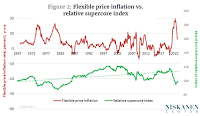
Supercore Inflation is Worth Watching, but it is Probably Not a Good Policy Target

Although headline inflation continues to fall and unemployment is near a 50-year low, the Federal Reserve still faces some tricky policy decisions over the next few months. Many of these have to do with the unusual volatility of relative prices during the 2021-2022 inflation, a topic that I wrote about in a recent commentary. This piece picks up where that one left off. It focuses on the behavior of the subset of prices that constitute the so-called supercore relative to prices that are more flexible.

Supercore prices have been in the news lately because some observers think the Fed is targeting them. This commentary will argue a focus on supercore inflation may have led to a more-than-prudent degree of monetary policy tightening by late 2022 and early  2023. The fact that high interest rates appear to have been a contributing factor to the banking crisis that was touched off by the failure of Silicon Valley Bank in March only strengthens the case.

So, what is the supercore?

So, what, exactly, is the supercore? The notion of ordinary core prices is familiar enough. The core consumer price index, for example, is the ordinary CPI with the highly volatile prices of food and energy removed. The personal consumption expenditures index, a CPI alternative, also has a core version that removes the same two sectors. Measures of the supercore go further by removing still more items.

Wednesday, February 1, 2023

Why the Inflation of 2021-22 Did Not Spiral Into Stagflation and Implications for Policy Going Forward

The ominous uptick in consumer prices that began in the spring of 2021 triggered alarm bells. By fall, the future looked dark to many observers.  A market strategist cited by Reuters warned that the surge in inflation would not be transitory, as the Fed and Biden administration were then promising. “Sticky and sustained” inflation when the country was “past peak growth” would constitute “stagflation," he said, reviving a term coined in the 1960s.

Yet there was no stagflation. The 2021-2022 episode turned out to be very different from the economic turmoil that bedeviled the U.S. economy from the 1960s into the early 1980s. Its brevity was one key difference. A second difference was a far greater volatility of relative prices. A third concerned the role of expectations. As this commentary will explain, these three differences, taken together, carry important lessons for policymakers. 

Thursday, December 22, 2022

No, Prof. Mankiw, Better Social Insurance Would Not Kill American Prosperity

In a recent New York Times op-ed, Harvard professor N. Gregory Mankiw asks, “Can America Afford to Become a Major Social Welfare State?” By welfare state, he has in mind the Biden administration’s plan for better child benefits, improved healthcare, extending free public education to preschool and community college, and the rest.

From a “narrow budgetary standpoint,” Mankiw agrees that these things are affordable. But he is concerned about the larger question of whether stronger social protections are consistent with prosperity and with our aspirations for the “kind of nation we want to be.” Let’s take each of those in turn.

Prosperity, for Mankiw, means GDP. Yes, America has lots of that. He points out that as of 2019, GDP per capita was 14 percent lower in Germany than in the United States, 24 percent lower in France, and 26 percent lower in the United Kingdom.

But GDP per capita has its limits as a measure of prosperity. It is, after all, an average whose numerator lumps together the incomes of billionaires and the incomes of the poor. True, the United States does pretty well in the billionaire sweepstakes. It has 19 percent more billionaires per capita than Germany, 2.7 times as many as the UK, and 3.2 times as many as France. But most people don’t count the “prosperity” of their city or town by the number of billionaires who live there. They are more interested in whether their neighbors, the people they stand in line with at their local supermarkets, can maintain a decent standard of living.

Tuesday, April 12, 2022

Four Perspectives on Individual Freedoms and Climate Change


On April 12, 2022, the University of British Columbia, Okanagen, sponsored an on-line symposium, "A Wicked Problem: Individual Freedoms and Climate Change." Here is a link to the slideshow of my presentation at the conference, which discusses four perspectives on the problem:

  • Carbon pollution as a violation of the nonaggression principle
  • Applying Lockean property rights to the climate problem
  • Climate change as a coordination problem
  • A Hayekian perspective: Prices without markets or markets without prices?