Wednesday, February 14, 2024

A Negative Income Tax, One Step at a Time

The negative income tax (NIT) sometimes seems like the carbon tax of social policy. Both are irresistibly appealing to economists and have long pedigrees. Both are supported by blindingly persuasive logic. Yet neither policy seems capable of mustering much political support in 21st-century Washington politics. I see two things as essential in repackaging the NIT for today’s America.

The first essential is to recognize the reality of path dependency — the need to start from where we are, not from a clean slate, and take things one step at a time.  Gerald Gaus calls that approach “exploring the adjacent possible.”

The second essential is to present the NIT in a value framework that has broad appeal across the political spectrum. As things stand, the NIT has about an even balance of progressive and conservative skeptics, yet properly implemented, it offers much that is in harmony with the values of both sides.

Here, then, are some ideas for nudging the NIT along from a merely an elegant concept toward something more concrete and workable.

Thursday, June 29, 2023

The War on Inflation: Victory at What Cost?

For more than a year, the Fed, led by its chair Jerome Powell, has been fighting the worst outbreak of inflation in the United States in 50 years. This slideshow, first presented at the Northport MI Lions Club on July 28, 2023, addresses three questions: 

  1. How are we doing?
  2. Why is inflation so hard to reverse?
  3. When will things get back to normal?
The bottom line: The good news is that inflation is falling faster than we might think from reports in the mass media. The bad news is that things are not yet back to normal. Trying to push the inflation fight too fast could do more harm than good.

Saturday, April 15, 2023

Corporate Political Responsibility in a Captured Economy

The social responsibility of business has been debated for years. One point of view follows Milton Friedman’s maxim, “In a free society … there is one and only one social responsibility of business – to use its resources and engage in activities designed to increase its profits.” Others argue for the priority of ESG values, even if they conflict with profit-making. A more pragmatic perspective sees ESG simply as a set of tools that facilitates risk assessment and enhances long-run profitability. 

The political responsibility of corporations has, unfortunately, received much less attention. Friedman himself alluded to political responsibility when he added the proviso that firms must “stay within the rules of the game” by pursuing profit through “open and free competition without deception or fraud.” Unfortunately, he failed to follow up by asking the critical question: In a free society, who makes the rules?

The rules of the game

There is little controversy about the basic rules of the game for free-market capitalism: respect property rights, compete openly and honestly based on price and quality, and follow common-law principles of fraud, nuisance, and negligence. The hot-button disputes over corporate political responsibility pertain not to the basic rules themselves, but to their application to issues that dominate the daily news, like environmental protection, railroad safety, or workers’ rights.

Friday, March 17, 2023

Supercore Inflation is Worth Watching, but it is Probably Not a Good Policy Target

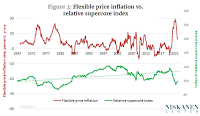
Although headline inflation continues to fall and unemployment is near a 50-year low, the Federal Reserve still faces some tricky policy decisions over the next few months. Many of these have to do with the unusual volatility of relative prices during the 2021-2022 inflation, a topic that I wrote about in a recent commentary. This piece picks up where that one left off. It focuses on the behavior of the subset of prices that constitute the so-called supercore relative to prices that are more flexible.

Supercore prices have been in the news lately because some observers think the Fed is targeting them. This commentary will argue a focus on supercore inflation may have led to a more-than-prudent degree of monetary policy tightening by late 2022 and early  2023. The fact that high interest rates appear to have been a contributing factor to the banking crisis that was touched off by the failure of Silicon Valley Bank in March only strengthens the case.

So, what is the supercore?

So, what, exactly, is the supercore? The notion of ordinary core prices is familiar enough. The core consumer price index, for example, is the ordinary CPI with the highly volatile prices of food and energy removed. The personal consumption expenditures index, a CPI alternative, also has a core version that removes the same two sectors. Measures of the supercore go further by removing still more items.

Wednesday, February 1, 2023

Why the Inflation of 2021-22 Did Not Spiral Into Stagflation and Implications for Policy Going Forward

The ominous uptick in consumer prices that began in the spring of 2021 triggered alarm bells. By fall, the future looked dark to many observers.  A market strategist cited by Reuters warned that the surge in inflation would not be transitory, as the Fed and Biden administration were then promising. “Sticky and sustained” inflation when the country was “past peak growth” would constitute “stagflation," he said, reviving a term coined in the 1960s.

Yet there was no stagflation. The 2021-2022 episode turned out to be very different from the economic turmoil that bedeviled the U.S. economy from the 1960s into the early 1980s. Its brevity was one key difference. A second difference was a far greater volatility of relative prices. A third concerned the role of expectations. As this commentary will explain, these three differences, taken together, carry important lessons for policymakers. 

Thursday, December 22, 2022

No, Prof. Mankiw, Better Social Insurance Would Not Kill American Prosperity

In a recent New York Times op-ed, Harvard professor N. Gregory Mankiw asks, “Can America Afford to Become a Major Social Welfare State?” By welfare state, he has in mind the Biden administration’s plan for better child benefits, improved healthcare, extending free public education to preschool and community college, and the rest.

From a “narrow budgetary standpoint,” Mankiw agrees that these things are affordable. But he is concerned about the larger question of whether stronger social protections are consistent with prosperity and with our aspirations for the “kind of nation we want to be.” Let’s take each of those in turn.

Prosperity, for Mankiw, means GDP. Yes, America has lots of that. He points out that as of 2019, GDP per capita was 14 percent lower in Germany than in the United States, 24 percent lower in France, and 26 percent lower in the United Kingdom.

But GDP per capita has its limits as a measure of prosperity. It is, after all, an average whose numerator lumps together the incomes of billionaires and the incomes of the poor. True, the United States does pretty well in the billionaire sweepstakes. It has 19 percent more billionaires per capita than Germany, 2.7 times as many as the UK, and 3.2 times as many as France. But most people don’t count the “prosperity” of their city or town by the number of billionaires who live there. They are more interested in whether their neighbors, the people they stand in line with at their local supermarkets, can maintain a decent standard of living.

Tuesday, April 12, 2022

Four Perspectives on Individual Freedoms and Climate Change


On April 12, 2022, the University of British Columbia, Okanagen, sponsored an on-line symposium, "A Wicked Problem: Individual Freedoms and Climate Change." Here is a link to the slideshow of my presentation at the conference, which discusses four perspectives on the problem:

  • Carbon pollution as a violation of the nonaggression principle
  • Applying Lockean property rights to the climate problem
  • Climate change as a coordination problem
  • A Hayekian perspective: Prices without markets or markets without prices?